Atrani at sunrise
Atrani is one of the smallest towns in Italy: a beach, a little square under the arch, and houses stacked up the valley. Before the day-trippers arrive it is completely yours, which is why I take most sunrise photoshoots here.

My own list, from Atrani: the walks, viewpoints, food stops and boat days I send friends to, grouped by town, with when to go and how long to allow.
Base yourself in Amalfi or Atrani and give the coast three or four days. Spend one on the Amalfi old town and an early morning in Atrani, one in Ravello's villa gardens, and one taking the 25-minute ferry to Positano or walking the Path of the Gods. Keep a spare day for a boat, the beach, or a food and wine afternoon in the Tramonti Valley. Not sure where to sleep? Read where to stay in Atrani.
Last updated:
I live in Atrani, so this is where my list starts. The two towns are a 10-minute walk apart, and most buses and ferries stop in Amalfi.
Atrani is one of the smallest towns in Italy: a beach, a little square under the arch, and houses stacked up the valley. Before the day-trippers arrive it is completely yours, which is why I take most sunrise photoshoots here.
The Cathedral of Sant'Andrea, with its striped facade and long flight of steps, is the centre of town. Walk past it and keep going uphill: the lanes behind the main street are quieter and full of small food shops.
A shaded path into the valley above Amalfi, past old paper mills and small waterfalls. It is a good escape on a hot day, when the seafront is crowded.
Ravello sits 365 metres above the sea, so the views are wide and the air is cooler. SITA bus 5110 and the Amico shuttle (10€ one way) climb up from Amalfi.
Two historic villas with gardens hanging over the coast. At Villa Cimbrone, walk to the Terrace of Infinity, a balcony of marble busts that looks straight down to the sea. In summer the Ravello Festival holds concerts in Villa Rufolo.
The road west of Amalfi is the most dramatic stretch of the coast, and the most crowded in summer. Take the ferry when the sea allows it: Amalfi to Positano takes about 25 minutes.
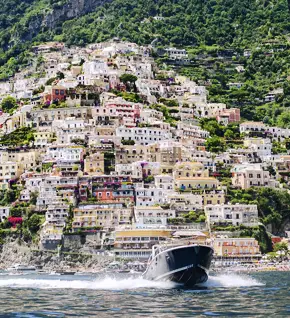
The most photographed town on the coast, with pastel houses falling down to a busy beach. Go for the view and a slow walk through the lanes, and expect the highest prices on the coast.
The famous walking trail high above Positano, starting near Agerola. You walk on a ledge between the mountains and the sea, with the whole coast below you.
Furore is a narrow fjord crossed by a road bridge, one of the most photogenic spots on the coast. A little further west, Praiano and Marina di Praia catch the best golden hour of the day.
East of Atrani the coast gets quieter and more local. Inland, the Tramonti Valley is where much of the coast’s food and wine comes from.
Fresh mozzarella at a small dairy, a tasting at a family winery, then up to the Valico di Chiunzi viewpoint at 880 metres, where you can see Vesuvius on a clear day.
Stop in Minori for pastries at Sal De Riso, swim on Maiori’s long beach, eat anchovies in the fishing village of Cetara, and finish in Vietri sul Mare, the town of hand-painted ceramics.
The coast looks different from the water, and some of its best corners can only be reached by boat.
Amalfi rentals often offer licence-free boats within local limits. Head for the Galli Islands, the sea caves and the coves you cannot reach by road, then anchor for lunch at a trattoria you can only reach from the water.
Maiori for space, Atrani for calm water, the coves near Erchie for privacy, Positano for the scene. The sea is warmest from June to September, at around 26-28°C.
Ferries run from Amalfi, Positano and Salerno to Capri in season. Take an early boat and check the return times before you go.
Most of the list above depends on buses, ferries and the weather. Check theSITA bus timetables andferry timetables for your dates, read theparking guide before you rent a car, and plan your arrival with theNaples Airport guide anddirections to Atrani.
Short answers about days, bases, cars and seasons.
Walk the lanes of Amalfi and Atrani, visit the gardens of Villa Rufolo and Villa Cimbrone in Ravello, take the ferry to Positano, and hike the Path of the Gods. Inland, the Tramonti Valley has mozzarella dairies and family wineries. From the water you can reach sea caves, the Galli Islands and Capri. Most towns are linked by SITA buses and seasonal ferries.
Three to four days is a comfortable minimum: one for Amalfi and Atrani, one for Ravello, one for Positano and the Path of the Gods, and a spare day for a boat, the beach or the Tramonti Valley. Buses and ferries are slow in summer, so it helps to stay in one central town, like Atrani or Amalfi, and take day trips from there.
Amalfi and Atrani are the most practical bases. They sit in the middle of the coast, Amalfi is the main hub for SITA buses and ferries, and Atrani is a 10-minute walk away but much quieter. Positano is beautiful but harder for transport, and Ravello is calm but up a steep road.
Yes. SITA buses link every coastal town, ferries run between Salerno, Amalfi and Positano in season, and parking is scarce and expensive anyway. A car is useful for the Tramonti Valley and the mountain roads, but you can also book a private car tour and let a local guide do the driving.
May, June and September are the sweet spot: warm sea, long days and fewer crowds than July and August. The beach season runs from around Easter to early November, and most ferry routes run from April to October. Winter is quiet and cheaper, with fewer boats and more local life.